The best roofing websites are not the flashiest ones. They're the ones that tell a homeowner, on the first screen of a phone, who you are, where you work, why you can be trusted with a roof, and how to reach you right now. The eight real sites below each do one of those things better than most, and every lesson on this page is something you can copy without a big redesign.
We picked independent and regional roofing companies from different parts of the country, checked each homepage on a desktop and a phone on October 8, 2026, and kept only sites we could praise without a list of caveats. Nobody paid to be here and we don't work with any of them. Each section names the one thing that site gets right and what to take from it for yours.
What separates a good roofing website from the rest?
A good roofing website wins the comparison a homeowner runs in about a minute: two or three roofers open in tabs, skimmed on a phone, and one call made to the company that looks most real. We wrote about that comparison in why roofers lose jobs to competitors with better websites. This page is the other side of it: real sites that pass.
Here's what to look for as you scroll:
- The first screen. Name, town, phone number and one clear next step, without scrolling.
- Proof that's yours. Your crew, your trucks, your roofs, reviews with names and dates.
- The questions roofing buyers actually have. Storm damage, insurance claims, warranty, financing.
- The phone. Most of this decision happens on one, so the call button has to be easy to find.
1. Yuras Roofing Company: the first screen does the whole job
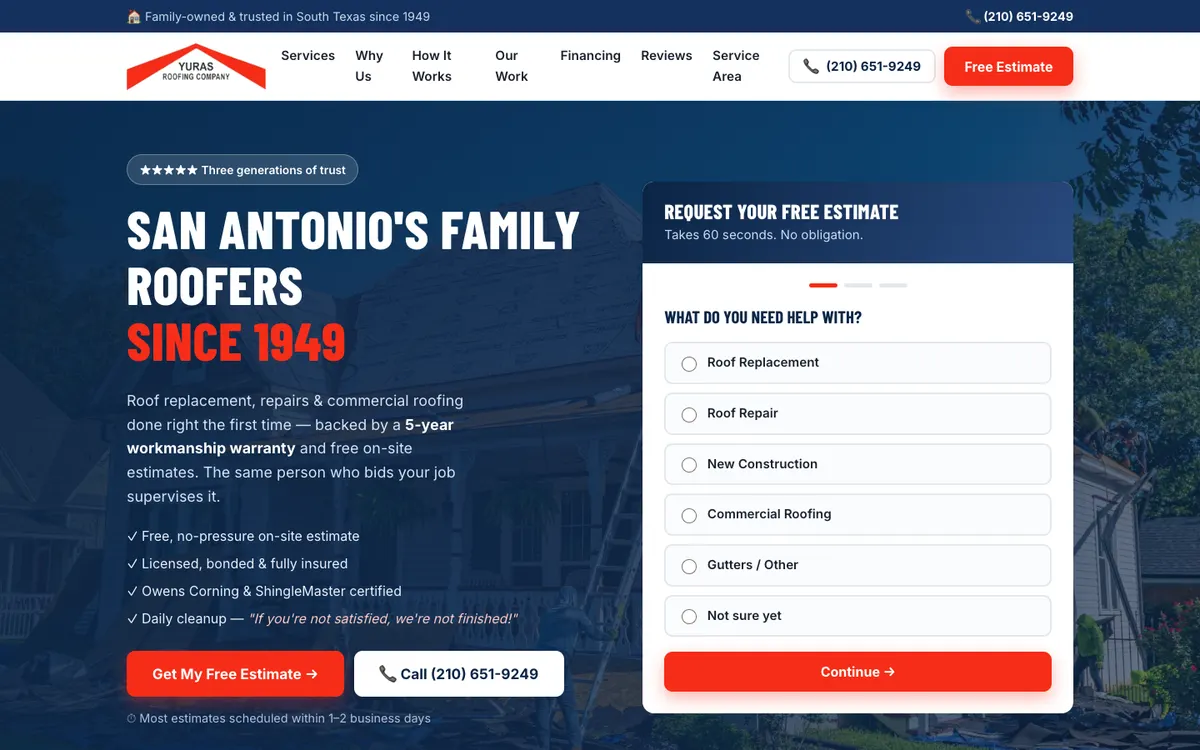
Everything a homeowner needs is above the fold. The top bar says "Family-owned & trusted in South Texas since 1949." The headline says who and where: "San Antonio's Family Roofers Since 1949." The phone number appears three times (top bar, header, and a big "Call" button), and there's exactly one main action, "Get My Free Estimate."
The line that does the most work is a small one: "The same person who bids your job supervises it." That's a specific promise, and specific promises beat adjectives. "Quality workmanship" is on every roofing site in America. A promise about who shows up is not.
The form helps too. It opens with one question ("What do you need help with?") and says "Takes 60 seconds. No obligation." right at the top, so a homeowner knows what she's signing up for before she starts.
Take this for your site: write down the one promise you make that competitors don't, and put it under your headline in plain words.
2. Phil DiBello Family Roofing: a real crew instead of stock photos
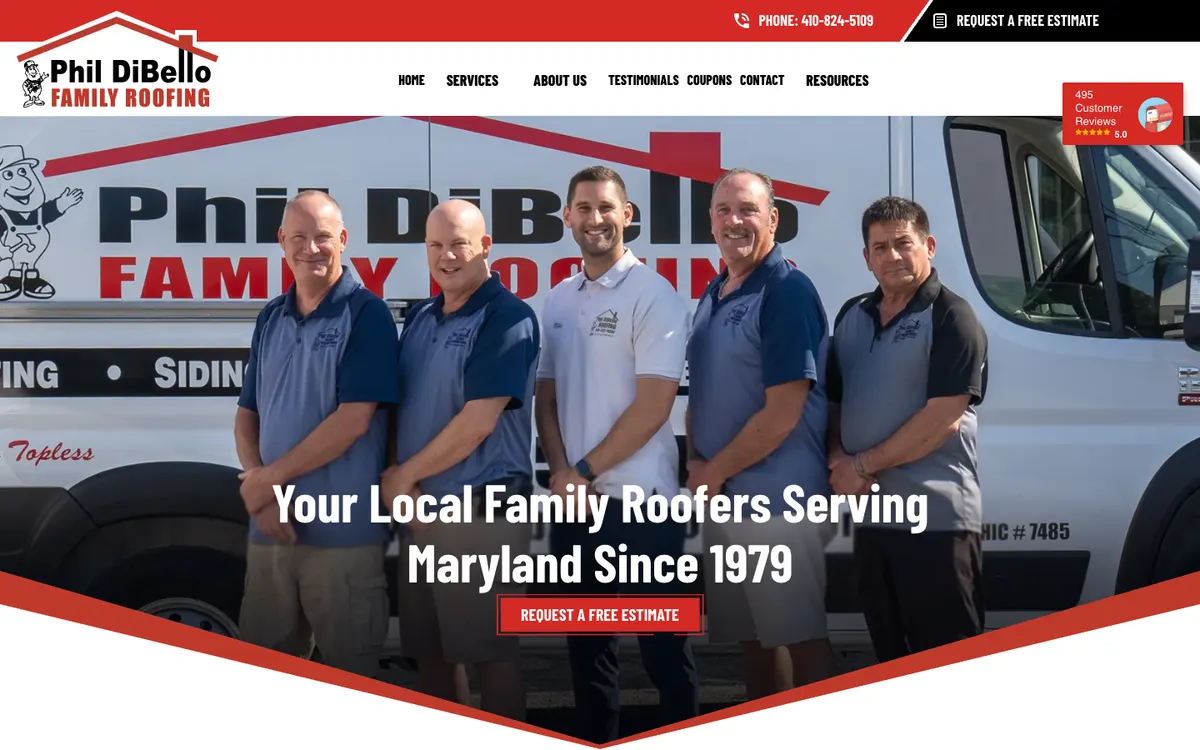
The hero photo is five people in company polos standing in front of a van with the company name on the side. No models, no stock house, no drone shot of a neighborhood that could be anywhere. A homeowner sees the faces behind the company name before she ever calls.
The reviews are handled well too. A "495 Customer Reviews" badge sits in the corner and leads to a testimonials page, and the homepage links out to the company's profiles on Google, Yelp, the BBB and Angi. Sending people to check you somewhere else feels risky, but it's the most convincing thing a review section can do: it says you have nothing to hide.
Take this for your site: one good phone photo of your crew next to your truck beats a hero image you bought. Schedule it for the next clear morning.
3. Lindholm Roofing: proof that's dated and local
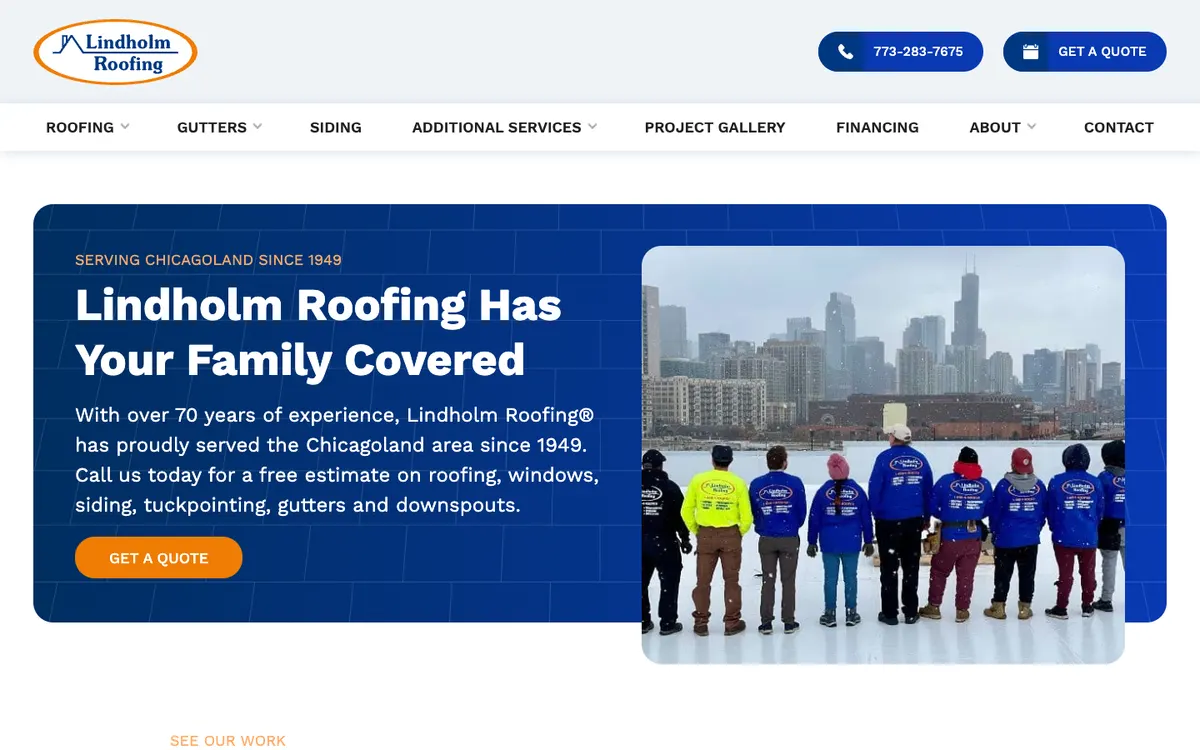
The hero photo is a crew in branded jackets on a snowy flat roof with the Chicago skyline behind them. Without a word of copy, it says "we're from here, and we work in the winter." That's local proof a storm chaser can't fake.
Further down, the homepage shows a Google review count next to a BBB rating, then a "Latest Customer Experiences" section with named reviews dated August and September 2026. The dates matter more than they look. A review from last month tells a homeowner the company is busy and still doing good work. A wall of undated praise could be ten years old.
The footer finishes the job with a "Serving All of Chicagoland" list that links to individual town pages, which is how a roofer shows up for searches in the suburbs, not just the city.
Take this for your site: show your newest reviews with their dates, and give each town you work in its own page once you have something real to say about it.
4. Cal Pacific Roofing: the warranty in plain words
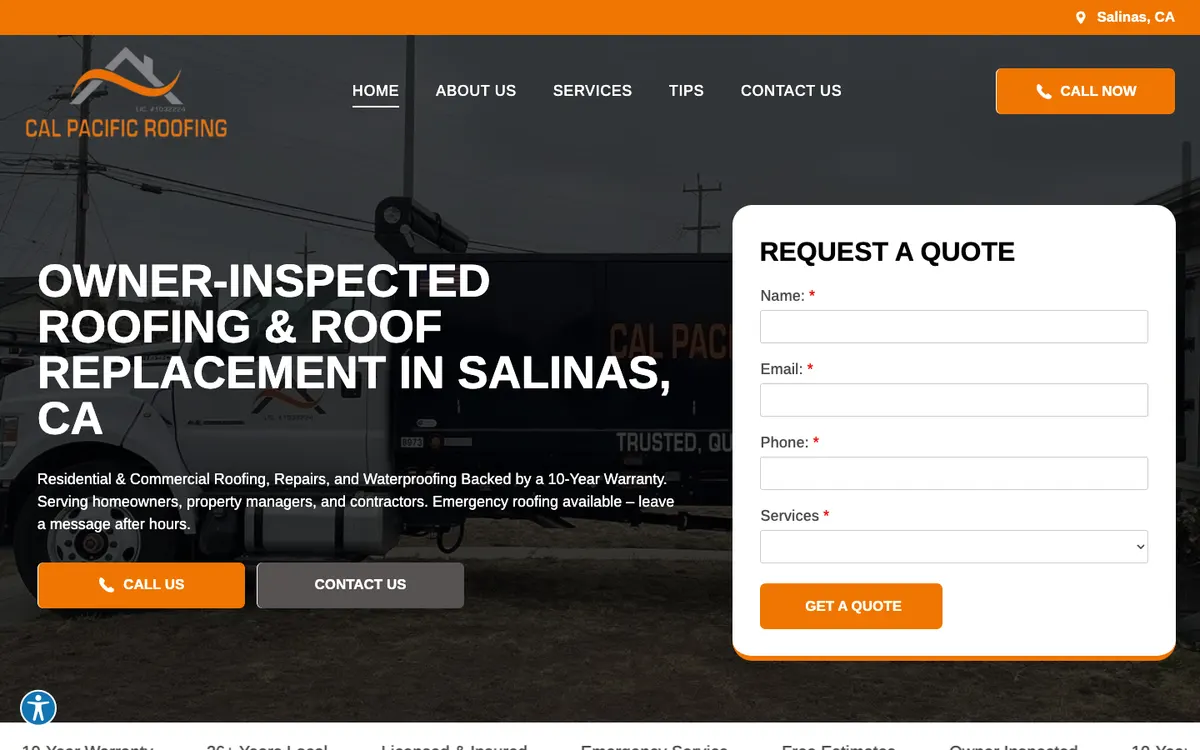
The headline leads with a promise, not a slogan: "Owner-Inspected Roofing & Roof Replacement in Salinas, CA." The line under it names the warranty and its length, says who they serve (homeowners, property managers and contractors), and tells you what happens after hours: emergency roofing, leave a message.
The FAQ backs the headline up instead of repeating it. It states the installation warranty on new roofs in plain terms and explains that the owners personally inspect the work on every project. A homeowner who reads that knows exactly what she's getting and who to hold to it.
Take this for your site: if you offer a workmanship warranty, put the length in your hero and explain what it covers in one short FAQ answer. Vague warranty talk sounds like there isn't one.
5. Garcia Roofing: storm and insurance help tied to local risk
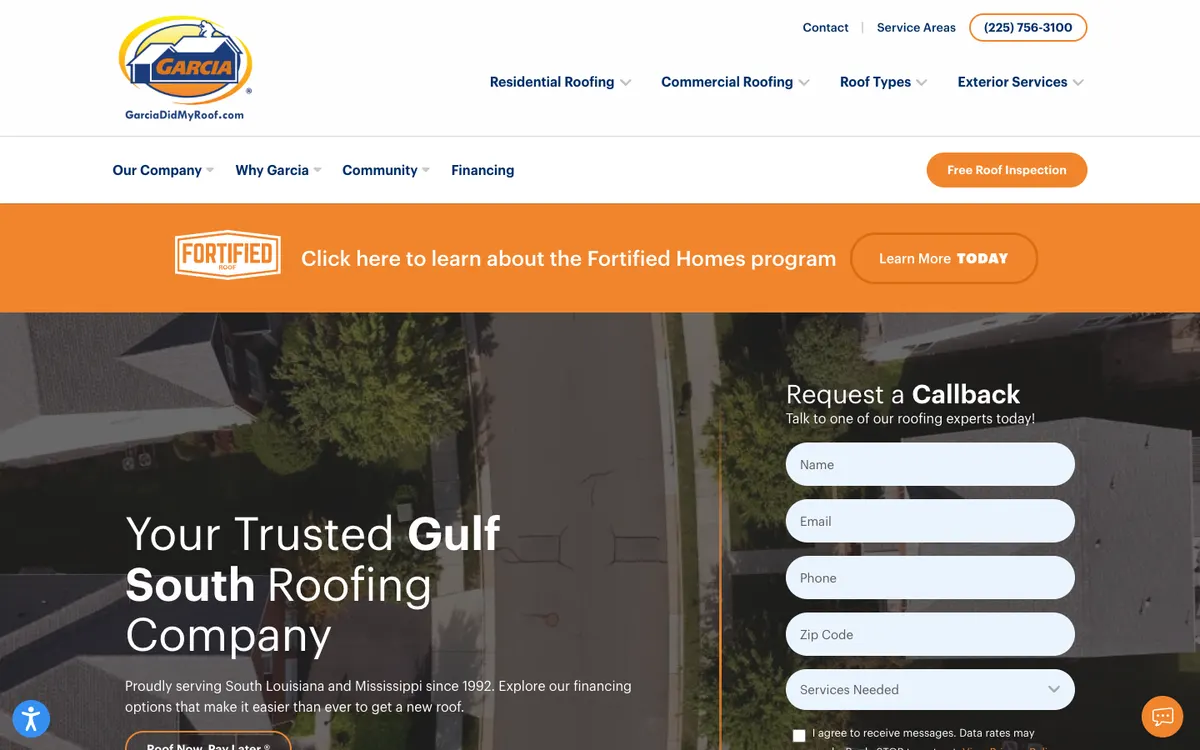
Garcia works in hurricane country, and the homepage acts like it. A banner right under the menu points to the Fortified Homes program with a "Learn More Today" button, which speaks straight to a Gulf Coast homeowner's biggest worry before the hero even starts.
The menus carry the rest: "Louisiana Insurance Claims" and "Storm Restoration" each have their own page, alongside separate residential and commercial roofing menus and a "Service Areas" page. The main button is "Free Roof Inspection," which is the right first step for a homeowner who isn't sure yet whether she has damage.
Take this for your site: name your region's real risk (hail, wind, hurricanes, ice dams) and give storm damage and insurance claims their own pages. Homeowners search for help with the claim, not just for a roofer.
6. Stay Dry Roofing: a phone layout with a bar that never scrolls away

Look at the bottom of that phone screen. Stay Dry pins three buttons there: "Call Now," "Text Us" and "Service Area." They stay put as the homeowner scrolls, so the next step is always one tap away, wherever she stops reading.
The "Text Us" button is the quiet win. A lot of homeowners find a roofer from work, or late at night, when calling isn't an option. Texting a photo of a water stain is easier than explaining it on the phone, and it starts the conversation before a competitor does.
The certifications are shown as badges near the top (the site names GAF Master Elite), which is the right place for a credential a homeowner may have heard of.
Take this for your site: pull your site up on your own phone. If the call button disappears once you scroll, fix that first. Add a text option if you can answer texts quickly.
7. Apex Roofing & Restoration: financing explained up front
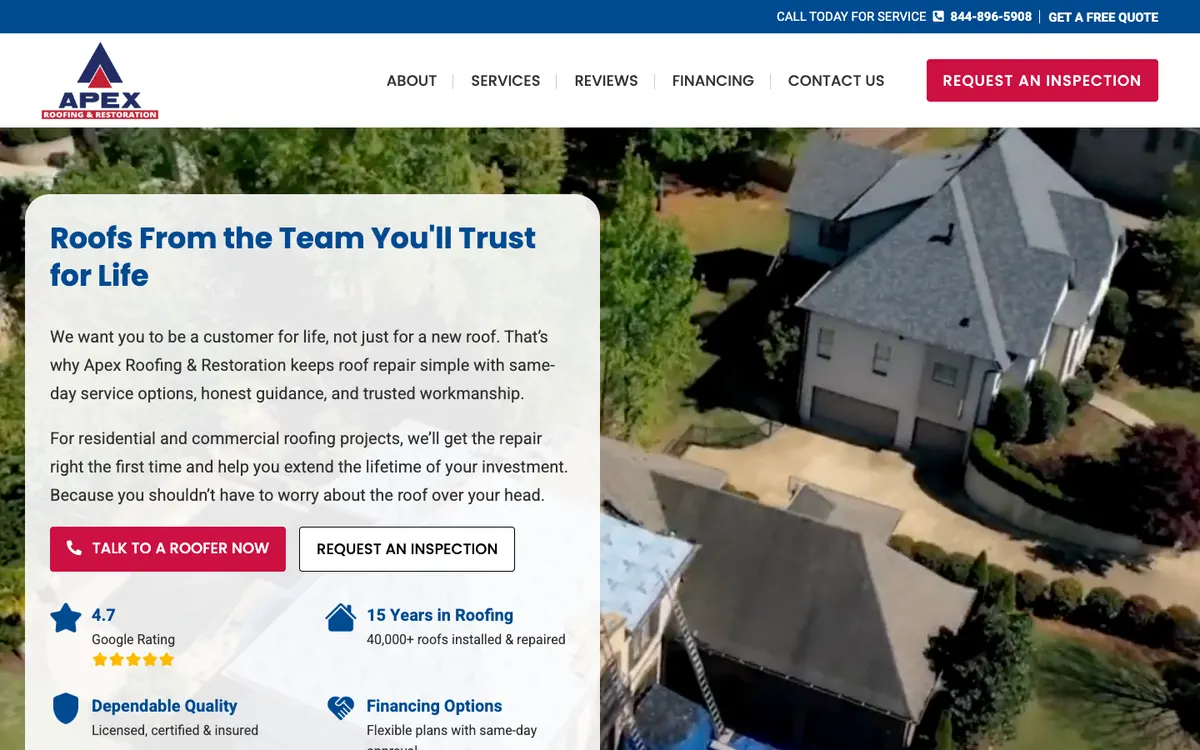
Apex is the biggest company on this list, with offices in several states, and it shows how to handle the money question without hiding it. Financing appears in the strip right under the hero buttons, and further down the homepage a section headed "Same-Day Approval" spells out the terms: payment plans "ranging from 12 to 180 months" and "$0 Down Options."
The hero also offers two buttons for two moods. "Talk to a Roofer Now" dials the phone for the homeowner with a leak. "Request an Inspection" is there for the one who's still deciding.
Take this for your site: if you offer financing, say so above the fold and state the terms in a sentence. A homeowner wondering whether she can afford a roof is a lead. A homeowner who has to call to find out is often someone else's lead.
8. Scudder Roofing Company: your work, labeled by town
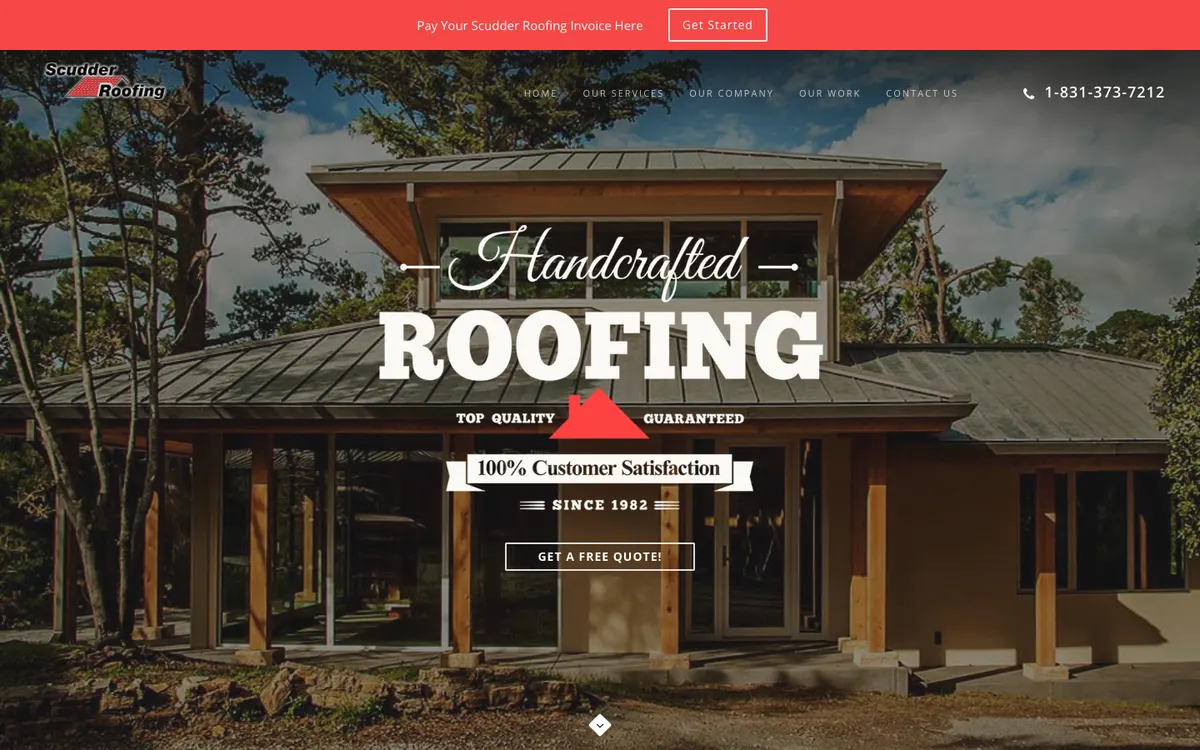
Scudder's homepage leads with one big photo of a metal roof and a short line: "Handcrafted Roofing," "Since 1982." Then it lets the work talk. Scroll down and there's a grid of projects with captions like "Custom Metal Roofing Project, Pebble Beach, CA" and "Cedar Shingle Roofing Project, Salinas, CA," followed by a link to the full portfolio.
Captions with a roof type and a town do two jobs. They tell a homeowner in that town that you've worked on her street, and they give search engines the words people actually type: the material and the place. Separate tiles for residential, commercial and solar sort the visitors early.
Take this for your site: every gallery photo gets a caption with the roof type and the town. It takes ten minutes and it's the most useful text on the page.
What all eight have in common
None of these sites won because of a design trend. They look different from each other, and that's the point. What they share is a short list of basics done well:
| What they do | Where you saw it |
|---|---|
| Name, town and a call button on the first screen | Yuras, Cal Pacific, Lindholm |
| Real crew and real roofs instead of stock | Phil DiBello, Lindholm, Scudder |
| Reviews a homeowner can check, with dates | Lindholm, Phil DiBello |
| Pages for storm damage and insurance claims | Garcia |
| The warranty stated in plain words | Cal Pacific, Yuras |
| Financing terms stated up front | Apex |
| A call bar that stays on screen on a phone | Stay Dry |
| Gallery photos captioned by roof type and town | Scudder |
If your site does five of those eight well, it's in better shape than most of your local competition. Our list of seven things every contractor website needs covers the same ground for every trade.
What this means for your website
You don't need any of these companies' budgets to copy what works. You need a clear first screen, your own photos, a few honest pages about storms, warranty and financing, and a call button that never hides. Most of it is writing and photos, not code.
If you'd rather not build it yourself, that's what we do. Modern Websites builds roofing websites around exactly this list: tap-to-call on every screen, storm damage and insurance pages, your crew and your roofs shown big, a gallery you can add to. It's $250 a month with everything included, no setup fee, month to month, and live in 7 days. See our pricing, browse example designs, or read what a contractor website should cost before you decide.
A note on the screenshots: each one shows a company's own homepage as it appeared on October 8, 2026, shown here because we think it does something well. If you own one of these companies and would like yours removed or updated, email henry@getmodernwebsites.com and we'll take care of it.